


TW: Descriptions of sexual intercourse, mentions and descriptions of erotic asphyxiation, descriptions of injury, descriptions of lasting bruises, mentions of death.
Introduction: the Sexual Ugly
Sexual performance has never really interested me.
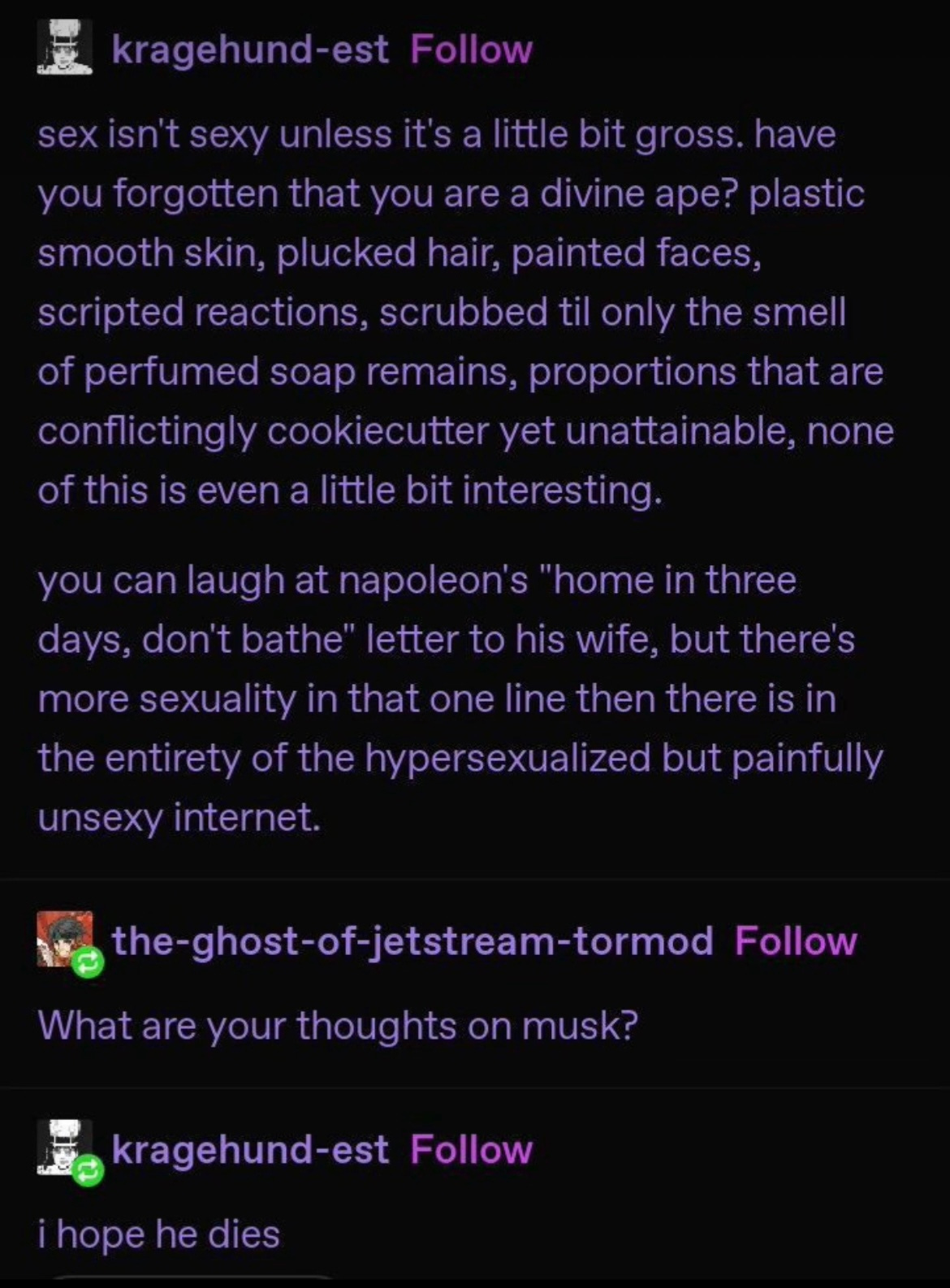
The intrigue of sex, for me, lies in its necessary grotesque humanness, rather than its socially-influenced propensity toward performativity. The hasty inconvenience, the panting, the sweat, the spit, the ill-timed gore. In its vulnerability, sex becomes a temporally undefined moment that permits an undoing of oneself that–in any other context–might be considered "ugly,"[1] in both senses of the word: “unpleasant in appearance”[2] and “involving or likely to involve violence or other unpleasantness.”[3]. This undoing is a fragile genesis—where boundaries dissolve, and the self is reborn amidst the tremble of intimacy. It’s permissible, if not sometimes preferential, for sex to be ‘ugly’: for make-up to smear, for skin to violet, and bruise into veiny reminders to look later upon in coy remembrance. To lose one’s verbal faculties, to be sodden, unconfined: these “departure[s]”[4] from standard conventions of beauty and sensibility are the expressions of a self freed from the “prescribed behaviour”[5] of beauty (often a significant control for who identify as women)[6]. This ‘ugly’ sex marks a rebellion: a refusal of the “unconscious sexual self-hatred”[7] and “insecurity”[8] demanded by a consumer culture that profits from women's dissatisfaction with themselves. However, the primal joy of these moments is sometimes underscored with a truer head-rush: that caused by erotic asphyxiation.
The cultural relevance of erotic asphyxiation cannot be overstated. Not only is the act heralded as typical[9], but also as a threat to public health. As a result of its dichotomous reputation, The UK Labour Party has proposed a ban on pornographic depictions of erotic asphyxiation, attempting to demotivate its practice. This proposition manifests the need to interrogate what it means to pursue the “...ultimate form of intimacy”[10], risk, and resistance, in the capital and control driven context of the contemporary Global North. If the Labour Party are correct that the proliferation of “dangerous online material”[11] (pornography depicting erotic asphyxiation), requires censorship because the act is “not only dangerous, but also degrading”[12], then the act of being choked—voluntarily, pleasurably—sits fricatively at the intersection of agency, and rebellion. If pleasure is shaped by power, then what is the macrocosmic effect of free surrender? What does it mean when that surrender becomes marketable? Is sexual censorship ever politically–as opposed to morally–appropriate? The purpose of this essay is not merely to critique pornography, nor to needlessly nor irresponsibly deny the real, and significant physical effects of asphyxiation. Rather, it aims to critically analyse the commodification of sexual rebellion, using erotic asphyxiation as its anchor-point. To achieve this, this essay draws on psychoanalytic theory alongside feminist critiques of capitalism. It uses them to inform a response to the aforementioned legislative plan to illuminate how erotic asphyxiation reveals tensions between agency and control. Erotic asphyxiation was chosen as this anchor-point not solely because of its topicality, but also because it exists at the upper echelon of what this essay calls ‘The Sexual Ugly’[13]: not ‘ugly’ as insult, but ‘ugly’ as truthful, raw, unguarded. ‘Ugly’ with neutrality, if not reverence.
Normatively speaking, ‘ugliness’ ought not be a morally-baked term. Therefore, for the purposes of this essay, it is taken only as the antonym to ‘beautiful’ which is in and of itself arbitrary, and so overdetermined that its meaning collapses under close scrutiny. However, I am not ignorant to the fact that social constructions lend force to the category of ‘ugly’, shaping how we interpret bodies, behaviors, and desires. Though ugliness ought not be inherently negative, and lacks an unequivocal form, it becomes observable and meaningful when contrasted to the policed ideal of (particularly feminine, which this essay is primarily concerned with) beauty. To further understand the tension between the grotesque, and the transcendent in sexual expression, one must turn to how theorists have approached the link between eroticism, transgression, and death. Sigmund Freud might call sex that deliberately navigates this crossroad a ‘perversion’— “a departure from the aim of reproduction and the pursuit of pleasure as such”[14]. What Freud viewed as pathological, Georges Bataille viewed as transcendent.
For Bataille, the transgressive taboo lies at the heart of eroticism: sexual pleasure is inextricable from the concept of the ‘forbidden’, and the forbidden is inextricable from death[15]. Through these lenses, erotic asphyxiation becomes a perversely sacrilegious sacrament—an extreme ritual through which the self dissolves at the edge of ecstasy and death. It is where liberation, mortality, and rebellion coalesce. It is a momentary flirtation with annihilation that feels, paradoxically, like complete presence. Asphyxiation has a maddening, and dizzying effect. It triggers an excitement exclusively describable as precisely primal. Each gasp is electric, the world tilting on a knife-edge between discomfort, and release, a tremble at the border where desire tastes destruction. The plain explanation for this feeling is ‘hypoxia’ (insufficient oxygen).
When asphyxiated, oxygen levels in the brain plummet. This can induce euphoria, and disinhibition. When combined with the brain’s loss of carbon dioxide (consequential of less blood reaching the brain), the dizziness aforementioned, along with tingling and–in some instances–visual and/or auditory hallucinations may ensue[16]. This experience is caused by a surge in endorphins, dopamine, and adrenaline, in similar volumes to those secreted during orgasm[17]. The biological responses outlined above account emphatically for asphyxiation’s animalistic thrill, but they do not attest to its symbolic pull, the existence of which is evidenced in its cultural pervasiveness, particularly in pornography. Capitalism—ever eager to metabolise rebellion—packages these once-radical expressions into consumable content, profiting even off of surrender. For this reason, erotic asphyxiation–insofar as it exists as a manifestation of the Sexual Ugly--might privately function as an unapologetically perverse site where gendered (particularly patriarchal) expectations of beauty, agency, and passivity collapse, and flesh speaks unabashedly. However, despite that erotic asphyxiation may be liberation from control, it risks reproducing the power structures it resists, especially as capitalism and pornography aestheticise and commercialise it. In its rawest form, erotic asphyxiation speaks to a desire not only for pleasure, but for disappearance from capitalist control—for ecstatic annihilation from the beauty panopticon. But this desire is not without danger, particularly when it is sold to us.
Written against the backdrop of, and responding to, the Labour party’s move to ban the viewing of pornographic content depicting erotic asphyxiation[18], this essay advocates for a deeper reckoning with the meaning of ‘choice’. In The Handmaid’s Tale, Margaret Atwood distinguishes between “freedom to”[19] and “freedom from,”[20]. She cautions that “...there is more than one kind of freedom... Freedom to and freedom from... Now you are being given freedom from. Don’t underrate it.”[21]. Whilst this line critiques authoritarianism, in the pornographic context it speaks to a subtler coercion: that of desire, particularly one as personal as carnality, shaped by market logic. When pornography simplifies the complex, transgressive potential of the Sexual Ugly into spectacle, the ‘freedom to’ weaponise it in rebellion against strict behavioural dictates becomes impossible. Thus, to prevent “being determined by others, particularly…men,”[22] and embody “the dark, inaccessible part[s] of [oneself who strives] to bring about the satisfaction of… [her] pleasure,”[23], one needs ‘freedom from’ the commodified representations of that very “pleasure”[24]. Therefore, this essay posits that the Labour government’s move to restrict the portrayal of erotic asphyxiation—albeit paternalistic—paradoxically preserves erotic freedom by safeguarding the conditions under which genuine, embodied choice becomes possible. This is not a glamorisation, sensationalisation of, or advocation for erotic asphyxiation. Rather this essay attempts to hold a volatile subject up to the light—to ask what our desires mean, where they come from, and what is at stake when they are sold back to us.
To unpack the symbolic force of erotic asphyxiation, this essay first explores the concept of the Sexual Ugly, before analysing the commodification of transgressive pleasure under capitalism, and finally considering the sociopolitical consequences of its portrayal in pornography.
Reclaiming the Sexual Ugly
The reality of sex as ‘ugly’ is not lost on anybody who has had it.
As previously mentioned, inextricable from the act is a loss of control. This manifests itself kaleidoscopically across the sexual imaginary: through orgasm, involuntary sound, mess, physical, and/or emotional vulnerability. Emphatically, it is often posited as central to sex in andro-supremacist, heterosexual sociocultural contexts, where male orgasm triggers sex’s alleged conclusion[25]. This essay claims that this loss of control is diametrically opposed to the sanitised behavioural schemas the everywoman is encouraged to claim as an identity under state capitalism. As such, this section, ‘Reclaiming the Sexual Ugly’, considers the emancipatory potential of embracing the Sexual Ugly—the raw, vulnerable, and often stigmatised aspects of sexual experience—as a form of resistance to neoliberal control.
In the capitalist context, the subject is “alienated from [her body], from pleasure, and from one another,”[26]. They become an abstraction. This is achieved in many ways: over-working her, long weeks that disallow the ability to accommodate relationships and hobbies that are not profit-aligned, idolatry of material goods, and striving for ownership thereof[27]. To alienate oneself from pleasure is to tolerate a lack thereof, to accept suffering, which for many living under capitalistic conditions is commonplace. Acquiescence to these conditions supports the “stability and efficiency of”[28] state capitalism, because the loss of one’s “moral stamina…turns her into a passive being who is prepared to tolerate anything,”[29]. This is valuable for the bourgeois within capitalism’s necessarily exploitative environment. Hence, under capitalism, the manageable (and managed) body is palatable, or ‘beautiful’. This ‘beauty’ is packaged as desirable–a foil to the Ugly–despite that it is merely a reimagination of “what the factory was for [the industrial] waged [worker]: the primary ground of their exploitation and resistance.”[30]. If this point is accepted, and the ugliness of sex is taken to be true, it then follows that only a few forms of “...sexuality [are] permitted,”[31], exclusively where they “do not threaten social control”[32]. For this reason, the engagement with the Ugly--and erotic asphyxiation insofar as it emblemises the Ugly–is an inherently politicised, transgressive act. The rebellion inextricable from the Ugly becomes particularly salient when one considers the “deeply female…plane”[33] on which “the erotic”[34], and hence ugliness operates.
“Cultural [fixations]”[35] on sex mirror those of the female body, which has been subject to patriarchal checks and balances in the same way that the proletariat has found her behaviours governed by state capitalism[36]. Through synonymising the feminine, the erotic, and the proletariat, the liberatory undercurrent of the Sexual Ugly lays itself bare and ready for ravaging: the deviant sexual participant “preserves what existed in the archaism of pre-objectal”[37] sociopolitical identities: ungovernable humanity. The “neoliberal culture [that] demands women be clean, contained, nice, and normal”[38] cannot coexist with the mess of the Ugly. By engaging the Ugly, people–in particular women–are freed. In their animalistic states, the “obsession about…beauty”[39] is destroyed, and so–too–is their compliance with the self-governance that “obsession”[40] is predicated upon: “...obedience”[41]. In this way, the “invisible…frightening”[42] “biopower”[43] of sex inherent to maintaining “social control”[44] under state capitalism through “positive influence”[45] is abolished by the “[uncurated]”[46] orgasm.
Because the Sexual Ugly has such liberatory power to resist the “precise controls and comprehensive regulations”[47] of state capitalism, it proves itself worth protecting for those seeking a life unencumbered by market forces. Therefore, where asphyxiation is attractive to those sexually active, it could be said that breath has power.
Breath as power
As above, the Ugly is liberatory. This is not to say that all sex must be deviant to be worthwhile. So-called ‘vanilla’ sex is enjoyable, and worthy sex. Rather, this essay claims that the choice to divest from performative sex, to reject capitalistic “cleanliness”[48], and fuck in a way that finds comfort and not “[threat]”[49] in “the fragile states where [woman] strays on the territories of animal,”[50] is an empowering one. To lack this “freedom to”[51] is “to exist… in the passive case”[52], where the “demands”[53] of “neoliberal culture”[54] and the “positive influence”[55] it has on its subjects denies one’s right to fuck as one’s perversions please. This point is made succinct, and compelling by Foucault: “Where there is power, there is resistance”[56]. However, this essay is aware that the desire to asphyxiate, or to be asphyxiated, has varying origin sources. In its ability to create a moment where power is both political, and pleasurable, it is critical to ask: who gets to choke, and who gets choked? Is asphyxiation a test of trust, a taste of death, or a reproduction of the same patriarchal, “neoliberal”[57] controls of the “[repeated]... acts…renewed, revised, and consolidated through time”[58] and politics that we refer to as “gender”[59]? it wishes to tear apart? In the following section, ‘Breath as Power’, this essay aims to unpack how breath functions symbolically, and materially within erotic asphyxiation. It does this by outlining the internal, biological desire to be asphyxiated and its implications, before identifying the externalist pressures to be asphyxiated.
Though the clasp of palms together around one’s neck feels like a perverse sort of prayer, one may find themselves asphyxiated for similar reasons that one may find themselves on their knees in exaltation. As outlined in the introduction, oxygen deprivation can cause euphoria, disinhibition, and hallucination, consequential to endorphin and dopamine spikes. For that reason, requesting to be choked during sex–a moment often already transcendent for physical, emotional, and spiritual reasons–feels reasonable. This point becomes further persuasive by reference to the alleged psychosexual motivations that one may have for requesting asphyxiation during sex.
Indeed, “the brain is the master sexual organ”[60], and therefore whilst the above, scientific explanation for why one seeks to be asphyxiated follows insofar as “sexual organ[s]”[61] are often also pleasure-seeking ones, it neglects the other ways that the brain may compute stimuli as sexual despite their distance from the sexual realm.
Sexual preferences are often shaped through experiences, and cultural inputs, marked as being of relevance during neurological development. This marcation occurs across the brain, although paramountly occurs within the mesolimbic dopamine system. Here, when exposed to an appealing stimulus, the brain releases dopamine within the ventral tegmental area, and the nucleus accumbens, which then tags the experience as rewarding and, therefore, desirable[62]. What is deemed as sexually appealing is also a matter of personal experience. Through Hebbian learning, the brain may associate certain seemingly innocuous acts as sexually appealing because they co-occur, or happen in close temporal proximity. The erotic conditioning of these instances is cemented in the amygdala, which assigns emotional significance to the act–as being, for example, exciting albeit taboo[63]. This point can be summarised accurately by the turn of phrase: “neurons that fire together, wire together”[64]. Between the amygdala and the prefrontal cortex, the innocuous becomes irresistible[65]. For the same reason, one may draw a neural link between the feeling of fear, and the dopamine, endorphins, and adrenaline that it generates as a sort of excitement that is not just chemical, but sensual.
Alternatively, one may find that their brain has eroticised the symbiosis of a trusting relationship. Here, the perception of danger (albeit simulated) may help them to draw closer–whether emotionally, or sexually–to their partner who does not take advantage of the surrender being gifted to them. This feeling may be compounded by the release of chemicals like oxytocin, often heralded as responsible for forging and close, emotional relationships[66], during the act of asphyxiation. Between regular, or monogamous, partners, this feeling may be encouraged by the firing of mirror neurons. These enhance arousal through the viewing of another’s positive, sexual reactions, and then create emotional and sexual synchrony[67]. Such moments reveal the profound alchemy of connection, where vulnerability becomes strength, and the gasp of losing air is a hymn to trust. Yet, even this most intimate alchemy does not exist in a vacuum. The pathways that link fear, trust, and pleasure are formed in a body that has been taught—by culture, by media, by history—what is erotic, and whose pleasure such surrender should serve.
The language used above has been very deliberate.
It speaks to the final way in which this essay seeks to present one’s motivations to be erotically asphyxiated, which is: one may find arousal in the symbolic dynamism of being choked. This is to say, one may find the expression of their desire for submission, and cessation of control to their partner who, then, attempts to wield it carefully sexually gratifying. This psychosexual catharsis is only made possible by this “power exchange”[68]--this stark dynamic of choker, and choked. But, who dictated that our pleasure should be sharpened into a blade, and handed–with longing–to another?
Despite that the above makes it clear that one could organically draw a neural link between an instance of extreme “power exchange”[69] and reward, such that the concept is sexually gratifying, it is naïve to suggest that any and all desire to be erotically asphyxiated stems from a hyper-organic route unadulterated by external socioeconomic forces. The cultural choreography of patriarchy, where femininity is rehearsed through yielding, and dominance is cast as an erotic birthright of masculinity is indeed performed freely, and honestly across bedrooms, but emphatically also across history, myth, and media–in particular within pornography.
Porn as pressure upon the throat
The above sections explored the intimate psychosexual grammar of asphyxiation. Now, the way that these impulses are manipulated, replayed, and consumed in capitalist culture will be explored. Although, as previously established, desire has neurochemical foundations, and therefore can be emotionally sincere, this sincerity lives in a socioeconomic context that demands rent in an ouroboros of influence and performance. Thus, pornography, as one of the most “accessible”[70] spheres of erotic imagination, becomes a stage where even the most private, and honest ugliness is made legible, marketable, and package-able on someone else’s terms.
The idea of an “antiporn feminism”[71], indeed, “conjures images of…censorial finger-waggers who mean to police every corner of our erotic imaginations”[72]. This image occurs largely due to their hyper-simplification of the complex nature of pornography to a few powerful words: it is “harmful to women”[73]. Whilst this essay is not chiefly concerned with–but completely agrees with the reality of–the “putative harms”[74] that pornography inflicts upon women, it must address them to be clear on its thesis. This is that “sexual activity, including sexual objectification”[75], and indeed asphyxiation, are not necessarily “[nor] inherently[,]harmful”[76], but rather their animation within a capitalist context, designed to commodify subversive desires, is. Here, where “context is everything”[77], there needn’t be a proscription of erotic variety, but rather of market forces bastardising, and repackaging it, and therefore disconnecting it from the complex, yet freeing space in which the Ugly exists. In this section, I critically examine how pornography mediates, and transforms the Sexual Ugly into a commercial spectacle, what this means for sexual agency under capitalism, and the ability to truly yearn for asphyxiation, and the wider Ugly.
The harms of porn on women are well-documented, and non-contentious, with “numerous studies”[78] indicating “a clear link between pornography consumption and attitude supportive of, as well as increased propensity for, violence against women and girls”[79]. This is a consequence of mainstream pornography’s heteronormative nature, which ritualistically posits “male dominance and female subordination”[80] as “ordinary”[81]. By animating the ancient cultural script of patriarchal gender relations, pornography demonstrates itself as “not merely [a depiction]”[82] of “unconcealed”[83] sexual intercourse, but rather as a “[documentation]”[84] of “social conditions”[85]. Therefore, because “porn…trains us in desire, even as it claims to reflect it”[86], consumers of pornographic content are subject to a circular logical fallacy: we are filming this because you like it, you are watching this because you like it, you like it because you have seen what we have filmed. With this in mind: if our desires are shaped by what we are shown, and what we are shown is designed to sell, then how truly free is our erotic agency? Capitalism doesn’t merely commodify the body—it dictates the pleasure erupting inside it, and the brain that seeks it. In light of this, a pornographically informed desire to be asphyxiated might just be the most seductive form of compliance, as evidenced in the anthropological foundations, and implications, of its pornographic performance.
Importantly, the aforementioned logical loop is indiscriminate in what it claims its consumers enjoy. Whilst erotic asphyxiation has become a cinematic convention indicating passion, it often occurs within a dramatically heteronormative context: a woman, petite and pleading, is choked by a man, virile, violent, and purportedly deserving–per his machismo–of her submission to how badly he wants her. Consumers rarely, if ever, are able to opt-out of comprehending erotic asphyxiation outside of this context, and therefore take it to be exclusively comprehensible in performance. It feels non-contentious to claim that this curated, aestheticised, commodified context is diametrically opposed, and patently incompatible, with the aforementioned “danger to identity”[87], and to the “ego”[88] described by this essay as the Ugly. What is Ugly about the “standardised visual [image]”[89] of femininity–purportedly effortlessly air-wrapped micro-links–being subject to domination(?)
This point is furthered by reference to the aforementioned Ugly, where the arbitrariness of what qualifies as “abject”[90], alienable from dictates of what is ‘beautiful’ proves pornography’s “[influence]”[91]. It is impossible (and childish) to claim that a close, clean shave, and an absence of adipose tissue, is objectively preferential to the converse. However, this standard is asserted within pornography. In this way, porn, like “feminine beauty”[92] proves itself “a cult”[93]--masquerading as being concerned with “pleasure”[94] but truly being “about control”[95]. Here, even the concerted desire to be asphyxiated because of its raw mess (both figuratively, and literally) in a deliberate rebellion is, in some ways, acquiescence to a standard of being prescribed by capitalism.
When the above is taken together with the dangers of asphyxiation, where even brief asphyxiation can lead to unconsciousness, long-term injury, or death[96], all of which can occur even days afterward, and where only half of people who experience asphyxiation will demonstrate physical injury (like markings on the neck, or petechiae–small blood spots in the eye, on the face, or head indicative of then-non-fatal strangulation) to make clear that she must seek medical attention[97], the government crackdown on its performance in pornography becomes a reasonable “[remedy]”[98]. This is not just on account of the obvious physical harms which suggest a broader public health issue, but also per the damage to “social conditions”[99] that purport to prioritise gender relations. Here, the essay is sympathetic to the government’s choice.
This said, the essay retains its original position: despite that the act of asphyxiation may appear–prima facie–”[degrading]”[100] or “controlling”[101], “violent”[102], or transgressive, it is possible for people to honestly want rough sex, to wish to be undone, because it is possible for people to generate these desires in contexts distinct from pornography. For this reason, it cannot accept that there is “any reason to assume that a submissive partner in a sadomasochistic context…is necessarily precluded from experiencing sexual pleasure”[103], and therefore that being choked is “inherently harmful”[104]. This essay champions one’s right to sexual liberty, and indeed the power that this liberty has over the “[colonisation of] desire”[105], femininity, and its associated aesthetic remit. Through dribbling on oneself whilst being choked, peach-fuzzed jaw unhinged to release the wet, guttural gurgle of losing oxygen, one who locates this desire in pornographically disconnected contexts finds the impossible space, as suggested by Jameson, “outside of capitalism”[106]. Here, she might tread the aforementioned line between human, and ‘animal’--and rejects the “neoliberal…form of reason that configures all aspects of existence,”[107] under global capitalism.
When this true Ugly is erased from the cultural consciousness by pornography’s increasing influence, much is lost. Skin that honestly welts, and slicks, and bruises without shame. Breath that shortens not from panicked acquiescence to a director’s bark, but from the blissful suffocation of being seen, uncurated. Without the Ugly, sex becomes smooth and exportable—ready to be streamed, cropped, and sold. We are left with performances rehearsed for someone else's gaze: pelvic rhythms timed to algorithm, groans made ambient, pain made polite. Desire is made into branding. Femininity becomes a costume one must never sweat through. In the absence of the Ugly, pleasure is sterilised, and power becomes something to pose rather than wield. The self that resists containment—the messy, animal, unmarketable self—is flattened for consumption. And in that flattening, the possibility of real liberation—bodily, erotic, political—bleeds out, quietly.
Conclusion
Erotic asphyxiation, in its rawest, least influenced form, may be a form of reclamation–of positioning the Ugly as a feminine, proletarian sexual truth. However, its current cultural packaging, tied beneath a ribbon of “[humiliation], control and [degradation of] the individual”[108] per the modern, heteronormative, pornographic optic, threatens to strip the act of its truth. This makes pleasure performance, and annihilation an aesthetic. As such, whilst the government’s choice to banish Ugly imagery seems a drastic, “imperious”[109] one, it actually preserves the ability for those who truly enjoy erotic asphyxiation not to “exist in the passive case”[110], to reject pornographic dictates of what sex ought to be (as a space in which women are necessarily “[exploited]”[111]), and instead pursue true taboo, to pleasure-seek in the ultimate way by prioritising a chemical bouquet of unadulterated, animalism over “cleanliness or health”[112], over sanitised sex, over “managing their own lives…[to] conform to market rationality”[113].
To be clear, this essay is not promoting the act of erotic asphyxiation during sex, necessarily. It urges its readers to be cognisant of the real, severe risks to life associated with it. However, it asserts that true erotic agency lies not in the act of erotic asphyxiation itself, but in the conditions under which that act is chosen. To allow the Sexual Ugly to be re-scripted by commercial aesthetics is to forfeit its radical potential—to transform rebellion into roleplay, and the body into a commodity. Therefore, no: erotic asphyxiation should not be visible in mainstream pornography. However, the right to breathe one’s way towards danger, towards bliss, towards loss of self, independently of the logics of commerce, must be retained–and we must be able to conceive of choking outside of pornography’s visual grammar. Where breath is power, choking—freely chosen—is not silence, but a scream against the sanitised performance of femininity under capital: one’s own refusal, one’s own ecstatic risk.
Citations
[1] Oxford Languages, Oxford University Press, accessed June 2025, https://languages.oup.com/
[2] Ibid.
[3] Ibid.
[4] Freud, Sigmund. Three Essays on the Theory of Sexuality. Trans. James Strachey. Basic Books, 2000, p. 150.
[5] Wolf, Naomi. The Beauty Myth: How Images of Beauty Are Used Against Women. New York: Vintage, 1991, p. 13.
[6] While this essay predominantly addresses the experience of cis women under heteropatriarchal and capitalist frameworks, it does not deny that the Erotic Ugly may manifest differently across queer, trans, and nonbinary experiences. Indeed, for many, ugliness is not transgression but assigned from birth—imbuing sexual rebellion with entirely different risks and liberations.
[7] Wolf, Naomi. The Beauty Myth: How Images of Beauty Are Used Against Women. New York: Vintage, 1991, p. 84.
[8] Wolf, Naomi. The Beauty Myth: How Images of Beauty Are Used Against Women. New York: Vintage, 1991, p. 137.
[9] Hone, Jane, ‘I think it’s natural’: why has sexual choking become so prevalent among young people?, The Guardian, 2024, https://www.theguardian.com/lifeandstyle/article/2024/sep/02/i-think-its-natural-why-has-sexual-choking-become-so-prevalent-among-young-people, accessed 28 July 2025.
[10] Ibid.
[11] Home Office, Strangulation in Pornography to Be Made Illegal (Gov.uk, 16 January 2024) https://www.gov.uk/government/news/strangulation-in-pornography-to-be-made-illegal, accessed 29 July 2025.
[12] Ibid.
[13] To prevent equivocation, ‘ugly’ refers to the social convention, whilst ‘Ugly’ (capitalised) refer to the concept put forward by the essay.
[14] Freud, Sigmund, Three Essays on the Theory of Sexuality, Trans. James Strachey, Basic Books, 2000, p. 150.
[15] Bataille, Georges, Erotism: Death and Sensuality, Translated by Mary Dalwood. City Lights, 1986 (originally published in French as ‘L’Érotisme’, 1957) (paraphrased from Chapter 1).
[16] Leigh, J. H., & Klemperer, K, Autoerotic fatalities: Clinical and pathological perspectives. Journal of Forensic Sciences, 49(5), 2004, p. 1147–1152.
[17] Komisaruk, B. R., Whipple, B., & Crawford, A, Brain activity during orgasm in women, The Journal of Sexual Medicine, 3(2), 2006, p. 330–339.
[18] Home Office, Strangulation in Pornography to Be Made Illegal (Gov.uk, 16 January 2024) https://www.gov.uk/government/news/strangulation-in-pornography-to-be-made-illegal, accessed 29 July 2025.
[19] Atwood, Margaret, The Handmaid’s Tale, McClelland & Stewart, 1985, p. 24.
[20] Ibid.
[21] Ibid.
[22] de Beauvoir, Simone, The Second Sex (1949), trans. Constance Borde and Sheila Malovany-Chevallier, Vintage Books, 2011, p. 267.
[23] Freud, Sigmund, New Introductory Lectures on Psycho-Analysis (1933), Lecture XXXI, trans. James Strachey, W.W. Norton & Company, 1965, p. 73.
[24] Ibid.
[25] Koedt, Anne, The Myth of the Vaginal Orgasm (1970), in Radical Feminism: A Documentary Reader, ed. Barbara A. Crow, New York: NYU Press, 2000, p. 205.
[26] hooks, bell, The Will to Change: Men, Masculinity, and Love, New York: Atria Books, 2004, p. 114.
[27] Marx, Karl, Economic and Philosophic Manuscripts of 1844, trans Martin Milligan (Progress Publishers 1959), p. 30.
[28] Marcuse, Herbert, One-Dimensional Man, Boston: Beacon Press, 1964, p. 78.
[29] Kollontai, Alexandra, ‘Society and Motherhood’ (1915) https://www.marxists.org/archive/kollonta/1915/motherhood.htm, accessed 31 July 2025.
[30] Federici, Silvia, Caliban and the Witch: Women, the Body and Primitive Accumulation, Autonomedia, 2004, p. 16.
[31] Ibid.
[32] Ibid.
[33] Lorde, Audre, Uses of the Erotic: The Erotic as Power, Paper delivered at the Fourth Berkshire Conference on the History of Women, Mount Holyoke College, 1978, p. 1.
[34] Ibid.
[35] Wolf, Naomi, The Beauty Myth: How Images of Beauty Are Used Against Women. New York: Vintage, 1991, p. 187.
[36] Federici, Silvia, Caliban and the Witch: Women, the Body and Primitive Accumulation, Autonomedia, 2004, p. 16.
[37] Kristeva, Julia Powers of Horror, An Essay on Abjection, trans. Leon S. Roudiez, Columbia University Press, 1982.
[38] Penny, Laurie, Unspeakable Things: Sex, Lies and Revolution, London: Bloomsbury, 2014, p. 51.
[39] Wolf, Naomi, The Beauty Myth: How Images of Beauty Are Used Against Women, New York: Vintage, 1991, p. 187.
[40] Ibid.
[41] Ibid.
[42] Firestone, Shulamith, The Dialectic of Sex: The Case for Feminist Revolution, Farrar, Straus and Giroux, 1970, p. 11.
[43] Foucault, Michel, The History of Sexuality, Vol. 1, trans. Robert Hurley, New York: Vintage, 1990 [1976], p. 137.
[44] Ibid.
[45] Ibid.
[46] Penny, Laurie, Unspeakable Things: Sex, Lies and Revolution, London: Bloomsbury, 2014, p. 51.
[47] Foucault, Michel, The History of Sexuality, Vol. 1, trans. Robert Hurley, New York: Vintage, 1990 [1976], p. 137.
[48] Kristeva, Julia, Powers of Horror: An Essay on Abjection, trans. Leon S. Roudiez, Columbia University Press, 1982, p. 4.
[49] Julia Kristeva, Powers of Horror: An Essay on Abjection, trans. Leon S. Roudiez, Columbia University Press, 1982, p. 71.
[50] Julia Kristeva, Powers of Horror: An Essay on Abjection, trans. Leon S. Roudiez, Columbia University Press, 1982, p. 12.
[51] Atwood, Margaret, The Handmaid’s Tale, McClelland & Stewart, 1985, p. 24.
[52] Carter, Angela, The Sadeian Woman and the Ideology of Pornography, Penguin Books, 1979, p. 77.
[53] Penny, Laurie, Unspeakable Things: Sex, Lies and Revolution, London: Bloomsbury, 2014, p. 51.
[54] Ibid.
[55] Foucault, Michel, The History of Sexuality, Vol. 1, trans. Robert Hurley, New York: Vintage, 1990 [1976], p. 137.
[56] Foucault, Michel, The History of Sexuality: Volume 1: An Introduction, trans Robert Hurley (Vintage Books 1990) p. 95.
[57] Penny, Laurie, Unspeakable Things: Sex, Lies and Revolution, London: Bloomsbury, 2014, p. 51.
[58] Butler, Judith, Gender Trouble: Feminism and the Subversion of Identity, New York and London: Routledge, 1990, p. 25.
[59] Ibid.
[60] McKenna, K, SSI Grand Master Lecture 3 ‘The brain is the master organ in sexual function: Central nervous system control of male and female sexual function’, International Journal of Impotence Research, 11(1), 1999, p. 1.
[61] Ibid.
[62] Georgiadis, J. R., Kringelbach, M. L, The human sexual response cycle: Brain imaging evidence linking sex to other pleasures, Progress in Neurobiology, 98(1), 2012, p. 49–81.
[63] Hamann, S, Herman, R. A, Nolan, C. L, Wallen, K, Men and women differ in amygdala response to visual sexual stimuli, Nature Neuroscience, 7(4), 2004, p. 411–416.
[64] Pfaus, J. G, Pathways of sexual desire, The Journal of Sexual Medicine, 6(6), 2009, p. 1506–1533.
[65] Ferretti, A, Dynamics of the amygdala response to emotional stimuli: Sex and age differences. Neuroscience Letters, 381(1–2), 2005, p. 17–21.
[66] Young, L. J, Wang, Z, The neurobiology of pair bonding, Nature Neuroscience, 7(10), 2004, p. 1048–1054.
[67] Rizzolatti, G, Sinigaglia, C, The functional role of the parieto-frontal mirror circuit: Interpretations and misinterpretations. Nature Reviews Neuroscience, 11(4), 2010, p. 264–274.
[68] Hone, Jane, ‘I think it’s natural’: why has sexual choking become so prevalent among young people?, The Guardian, 2024, https://www.theguardian.com/lifeandstyle/article/2024/sep/02/i-think-its-natural-why-has-sexual-choking-become-so-prevalent-among-young-people, accessed 28 July 2025.
[69] Ibid.
[70] Donevan, Meghan, Exposing pornography's true nature: A conceptual framework, Women's Studies International Forum, 109, 2025, p. 1.
[71] Eaton, A. W, A Sensible Antiporn Feminism, Ethics, 11(4), University of Chicago Press, 2007, p. 674.
[72] Ibid.
[73] Ibid.
[74] Ibid.
[75] Craig, Ellen, Capacity to Consent to Sexual Risk, New Criminal Law Review: An International and Interdisciplinary Journal, 17(1), 2014, p. 113.
[76] Craig, Ellen, Capacity to Consent to Sexual Risk, New Criminal Law Review: An International and Interdisciplinary Journal, 17(1), 2014, p. 103.
[77] Ibid.
[78] Donevan, Meghan, Exposing pornography's true nature: A conceptual framework, Women's Studies International Forum, 109, 2025, p. 2.
[79] Ibid.
[80] Ibid.
[81] Ibid.
[82] Ibid.
[83] Donevan, Meghan, Exposing pornography's true nature: A conceptual framework, Women's Studies International Forum, 109, 2025, p. 1.
[84] Donevan, Meghan, Exposing pornography's true nature: A conceptual framework, Women's Studies International Forum, 109, 2025, p. 2.
[85] Craig, Ellen, Capacity to Consent to Sexual Risk, New Criminal Law Review: An International and Interdisciplinary Journal, 17(1), 2014, p. 127.
[86] Srinivasan, Amia, The Right to Sex, London: Bloomsbury, 2021, p. 63.
[87] Kristeva, Julia, Powers of Horror: An Essay on Abjection, trans. Leon S. Roudiez, Columbia University Press, 1982, p. 71.
[88] Ibid.
[89] Bordo, Susan, Unbearable Weight: Feminism, Western Culture, and the Body, University of California Press, 1993, p. 25.
[90] Kristeva, Julia, Powers of Horror: An Essay on Abjection, trans. Leon S. Roudiez, Columbia University Press, 1982, p. 4.
[91] Donevan, Meghan, Exposing pornography's true nature: A conceptual framework, Women's Studies International Forum, 109, 2025, p. 1.
[92] Despentes, Virginie, King Kong Theory, trans. Frank Wynne, Feminist Press, 2010, p. 22.
[93] Ibid.
[94] Ibid.
[95] Ibid.
[96] Institute for Addressing Strangulation, Information for Victims of Strangulation, NHS, 2023, https://www.shsc.nhs.uk/sites/default/files/2023-07/IFAS-01-Patient-Information.pdf, accessed 1 August 2025.
[97] Ibid.
[98] Eaton, A. W, A Sensible Antiporn Feminism, Ethics, 11(4), University of Chicago Press, 2007, p. 674.
[99] Craig, Ellen, Capacity to Consent to Sexual Risk, New Criminal Law Review: An International and Interdisciplinary Journal, 17(1), 2014, p. 127.
[100] Home Office, Strangulation in Pornography to Be Made Illegal (Gov.uk, 16 January 2024) https://www.gov.uk/government/news/strangulation-in-pornography-to-be-made-illegal, accessed 29 July 2025.
[101] Ibid.
[102] Ibid.
[103] Craig, Ellen, Capacity to Consent to Sexual Risk, New Criminal Law Review: An International and Interdisciplinary Journal, 17(1), 2014, p. 113.
[104] Ibid.
[105] Berardi, Franco, The Soul at Work: From Alienation to Autonomy, Semiotext(e) 2009, p. 94.
[106] Fredric Jameson, Postmodernism, or, The Cultural Logic of Late Capitalism, Duke University Press 1991.
[107] Brown, Wendy, Undoing the Demos: Neoliberalism’s Stealth Revolution, Zone Books, 2015, p. 17.
[108] Donevan, Meghan, Exposing pornography's true nature: A conceptual framework, Women's Studies International Forum, 109, 2025, p. 2.
[109] Eaton, A. W, A Sensible Antiporn Feminism, Ethics, 11(4), University of Chicago Press, 2007, p. 674.
[110] Carter, Angela, The Sadeian Woman and the Ideology of Pornography, Penguin Books, 1979, p. 77.
[111] Donevan, Meghan, Exposing pornography's true nature: A conceptual framework, Women's Studies International Forum, 109, 2025, p. 2.
[112] Kristeva, Julia, Powers of Horror: An Essay on Abjection, trans. Leon S. Roudiez, Columbia University Press, 1982, p. 4.
[113] Foucault, Michel, The Birth of Biopolitics: Lectures at the Collège de France, 1978–1979 (Michel Senellart ed, Graham Burchell tr, Palgrave Macmillan 2008), lectures 10–12, p. 239–267.